Swiss Helicopter History
by Markus Herzig
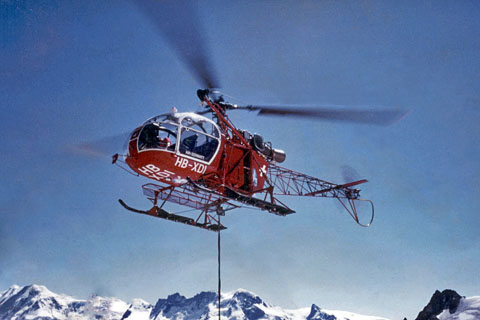
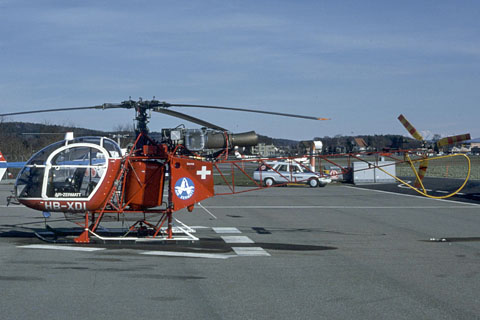
HB-XDI

HB-XDI, the 1st swiss Lama, at Aeschi
Photo Archiv Hans Zurniwen © Mar-81
Pax flight to Zurich airport
Photo by Heinz Meier © 1987

SA.315B Lama s/n: 2207 Built: 1971 s/n History: HB-XDI
Operator / Owner Registered Cancelled Remarks
Air Zermatt AG 1971-04-05 Current currently stored for rebuild
       

The 35th anniversary of the SA. 315B Lama in Switzerland

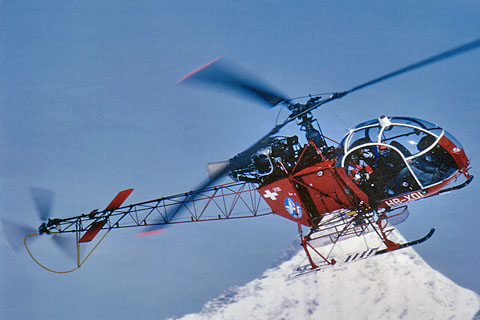
The Aérospatiale SA. 315B Lama helicopter flies in Switzerland since 35 years! On April 5, 1971 Air Zermatt registered its first helicopter of this type, the famous HB-XDI (s/n 2207, b/y 1971). The arrival of this new turbine-powered helicopter marked a big step ahead in the field of aerial works. Up in the high mountains this helicopter found its ideal space, and still today after more than 37 years after its first flight (it flew for the first time on March 17, 1969) very few helicopters are in the position to compete with this “flying mule”. Other Swiss helicopters companies soon understood that this machine promised a brilliant future and ordered it before the end of 1971: among them we find Air Glaciers with the HB-XDG (s/n 2221, b/y 1971), Air Zermatt (second Lama HB-XDL s/n 2225, b/y 1971) and Eliticino (HB-XDN, s/n 2232, b/y 1971)..

Brief history and technical description
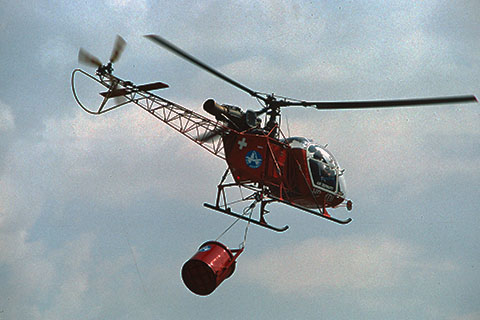
The SA. 315B Lama is a light multi-role helicopter powered with a Turboméca Artouste III turbine. From a structural point of view the Lama is very similar to the Alouette 2. It is however immediately recognizable from its predecessor for its high skid landing gear and the three blades tail rotor. The glazed cabin seats pilot and one passenger in front and three passengers behind on a foldable bench. The helicopter can lift sling loads up to 1135 kg. For SAR operation it can be equipped with an hoist (capacity 160 kg). Its main roles are: aerial crane and passengers transport, SAR ops, liaison, observation, training, agricultural and photographic missions.

This helicopter was designed using components of the Alouette 2 and Alouette 3 and combines the qualities of both of them. Initially it was designed to meet a requirement announced by the Indian armed forces. The prototype registered F-WPXS made its first flight on March 17, 1969. On June 21, 1972 a Lama piloted by French Jean Boulet (holder of a previous record with a SE. 3150 Alouette 2, the predecessor of the Lama) set an absolute altitude world record with 12’442 meters.. Like other helicopters produced by  Aérospatiale/Eurocopter (Alouette, Puma, Gazelle, etc.) the SA. 315B received the name of an animal. The Lama owes its name to the fact that it was designed for operation at high altitude like the pleasant Andes animal. In India it is known as Cheetah and in Brasil as Gavião (Sparrow Hawk). The French certification was granted on  September 30, 1970 and FAA Type Approval on February 25, 1972. The total production (Aérospatiale, HAL, Helibras) exceeds 600 units.
 

Heli-Archive Bazzani - April 2006

Aérospatiale SA.315B Lama
Helicopter type Light multi-role turbine powered helicopter
Engine Turboméca Artouste IIIB
Max turbine power: 870/640 hp/kW
Max continuous power: 550/405 hp/kW
Fuel capacity: 575 litres
Std fuel consumption: 220 l/h
Dimensions
Main rotor diameter: 11.02 m
Tail rotor diameter: 1.91 m
Fuselage length: 10.26 m
Height: 3.09 m
Width: 2.38 m
Weights
Empty weight: 1100 kg
Max take-off weight: 1950/2300 kg (int./ext load)
External sling load: 800 kg
   
Take-off weight at 1500 kg at 1950 kg at 2300 kg
Performances*
Service ceiling: >7000 m 5400 m 3000 m
Hovering IGE: 6995 m 5050 m 2950 m
Hovering OGE: 6995 m 4600 m 1550 m
Initial rate of climb at sea level: 470 m/min 330 m/min 235 m/min
  Others general performances
Vne: 210 km/h
Nrm cruising speed 160 km/h
Std range 550 km
*in zero wind at sea level and with standard atmosphere conditions

Page last updated: 6-Apr-2006
Copyright © 2006 by Markus Herzig. All rights reserved. No content of this site may be used without prior permission.
COPYRIGHT - DISCLAIMER