|
The 40th
anniversary of the Alouette III in Switzerland
The
1965 has been an important year for the rotary wing in Switzerland. It
saw in fact the birth of new helicopters’ companies like Eliticino (founded
by Claudio Valsesia – see the history of HB-XBY
and Air Glaciers. This last was founded in Sion/Valais by Louis d’Allèves,
Hermann Geiger and Bruno Bagnoud on August 1st. The original fleet included
airplanes - like, for example, the Piper Super-Cub and the Pilatus PC-6
Porter - and two helicopters: a Bell 47J HB-XAU
and an Agusta-Bell 47J3B-1 HB-XCA. Few days after
the official start of the flight activities the helicopters’ fleet was
reinforced with the arrival of a new machine due to meet a great success
in Switzerland, the Alouette III.
Brief
history and technical description
The
French Alouette III is the successor of the Alouette II. The prototype
F-ZWVQ made its first flight on February 1959 with the pilots Jean Boulet
and Robert Malus. Larger and more powerful than his predecessor, it has
a cabin which can accommodate six passengers (two in front beside the pilot
and the other four on a foldable rear bench). The cabin is almost totally
enclosed with large plexiglas panels. In this helicopter the excellent
view in all directions is a characteristic very much appreciated especially
by pilots. The access to the cabin is possible trough 4 doors, one opening
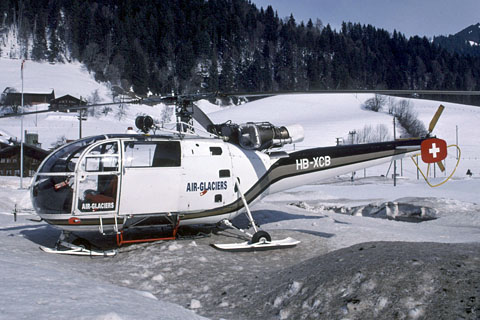
forward and one sliding rearward on each side. The helicopter has a tricycle
landing gear with optional skis for operations on snow, but it can be equipped
with floats too.
The
SA.3160 (the first version introduced on the market) is equipped with a
turbine Turboméca Artouste IIIB with a nominal rated power of 870
ch (550 cv maximum continuous power) which turns a three blades main and
tail rotor. Since the first flights the new helicopter showed excellent
flight characteristics being very stable, fast and maneuverable. On high
altitude operations the reserve of power was considerable, and the helicopter
was able to land and take-off with its full load at over 2000 meters. To
promote the new Alouette III, in June 1960 Boulet landed with 4 passengers
and a payload of 150 kg on the Mont Blanc at an altitude of 4810 m. Even
more spectacular were the flights made in the Himalayan chain in Autumn
of the same year when the helicopter landed and took off on the “Dec Tibaa”
at 6004 m with two pilots and 250 kg of payload. In Summer of the following
year the first Alouette III was sold to a military customer. The civil
certification followed on December 15, 1961 (the FAA certification was
released on March 27, 1962).
The
arrival of the Alouette III in Switzerland
In
the early ‘60s the few helicopters flying in Switzerland were light piston
powered machines, mostly of which were in service with Heliswiss based
in Berne. Among the few other helicopters there was the Bell 47J HB-XAU
of the famous Valaisan pilot Hermann Geiger, known for his spectacular
air rescues in the Swiss Alps using light airplanes like the Piper PA-18
Super Cub.
The
limitations of the ”Jay” model were quite evident, lack of power being
the first. Things changed a bit with the arrival of the new turbo-charged
Agusta-Bell 47J3B-1 HB-XBR in Autumn 1964 (and
unfortunately destroyed the following Spring in Liddes/Valais). To Geiger
and his work colleague Fernand Martignoni it was clear that the best answer
to their needs was the new turbine powered helicopter. The SE.3160 was
in fact more than a step forward if compared to the Bell 47J serie. The
only obstacle between the new “work-horse” and the Valaisans pilots was
at that point only its high purchase price! The problem was eventually
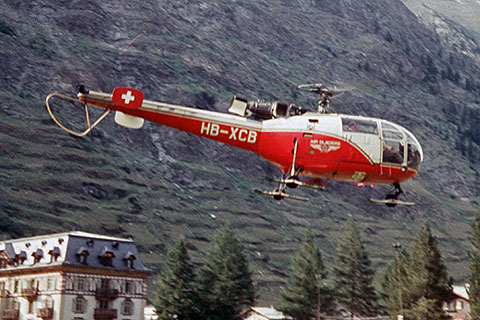
overcome and on August 6, 1965 - few days after the official foundation
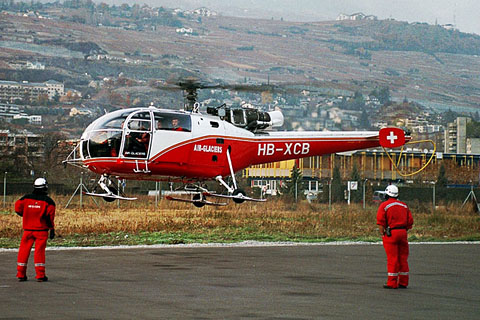
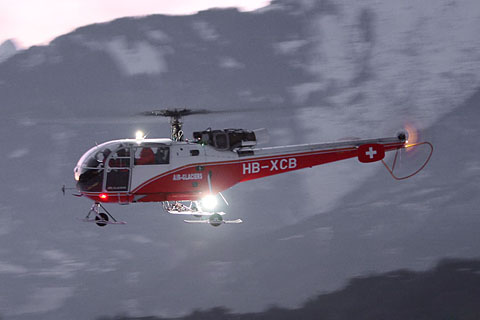
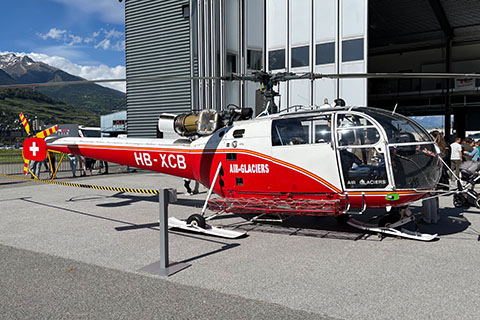
of the Air Glaciers - Geiger landed in Sion with his brand new SE.3160
Alouette III which received the Swiss matriculation HB-XCB or more simply
“Charlie-Bravo”.
Immediately
after the first flights the new helicopter confirmed to be the right choice.
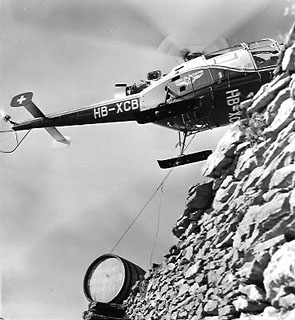
Its remarkable power reserve was very appreciated, especially for rescue
missions and transport of passengers and freight. Among the first “special
missions” assigned to the Charlie-Bravo were the air rescue of the
Pilatus PC-6 Porter HB-FAP damaged on August 20, 1965 during a landing
on the Wildhorn. Geiger transported the wreck in three flights (engine
and propeller, wings and various pieces, and at last the fuselage). On
August 31, 1965 after the tragedy occurred during the construction of the
Mattmarksee dam - an artificial mountain lake in Valais close to the border
with Italy - the helicopter was intensively used as air ambulance. In the
tragedy, caused by the fall of an enormous mass of snow and ice, the shacks
of the workers were overturned killing 88 of them, more than half of which
were Italian immigrants.
|
February
4th, 1974 another tragic day
On
that date the helicopter was flying a routine mission, the transport of
2 workers of the Italian electrical company ENEL. The flight was proceeding
without problems when suddenly the Alouette III collided with the cables
of a power line. In the accident the French pilot Pierre Pellegrin lost
his life together with his flight assistant and one worker. The second
passenger miraculously survived reporting only minor injuries. Totally
destroyed the helicopter was rescued and placed for long years in an hangar.
On October 14, 1976 the registration was canceled from the Swiss civil
helicopters’ register, and everybody tough that the life of Charlie Bravo
definitely ceased.
The
rebirth of the Phoenix
After
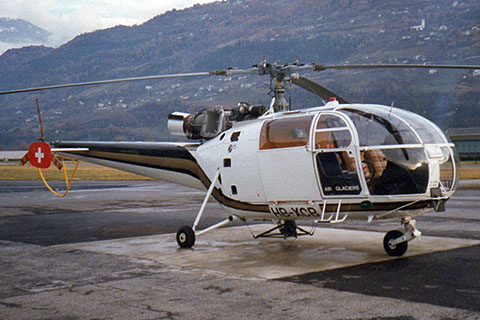
several years the mechanics of Air Glaciers started to rebuild the helicopter.
Like the Phoenix - the mythological bird able to rise from its ashes -
the HB-XCB in 1987 took again to the air, this time with a new paint scheme,
and no more as SE.3160 but as SA. 316B, a newer version with strengthened
main and rear rotor transmission, higher take-off weight (2200 kg instead
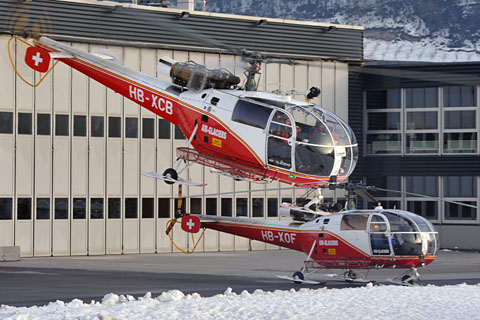
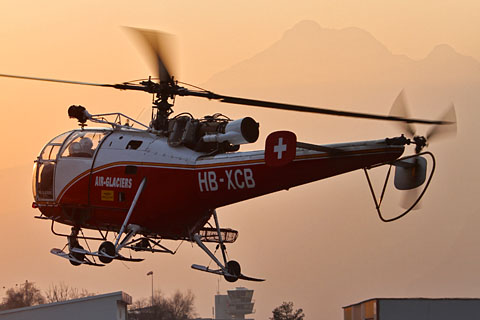
of 2100 kg) and payload. Today the helicopter is painted with its original
colours, typical of the Air Glaciers fleet. From the above it clearly appears
that between the Valaisan helicopter’s company and the Alouette III there
is a special feeling, even if new models are now in service. That is probably
the main reason why today we have the opportunity to celebrate the 40th
anniversary of the HB-XCB the “St. Bernhard of the air” (the famous dog
known worldwide as “the dog that rescues people” in the Swiss Alps), a
nickname used frequently in the past to indicate the Alouette III.
Thank
you Air Glacier and… Happy Birthday!
Heli-Archive
Bazzani/July 2005
Data
SE. 3160 Alouette III
The
SE. 3160 Alouette III (which means Lark) is a light French multi-role turbine
powered helicopter. Normal accommodation is for a pilot and 6 passengers.
In civil SAR missions the helicopter is equipped with a single stretcher
and a rescue hoist mounted in the port side of the cabin.
| Engine: |
Turboméca
Artouste IIIB |
| Max
turbine power: |
870/640
hp/kW |
| Max
continuous power: |
550/405
hp/kW |
| Fuel
capacity: |
565
litres |
| Std
fuel consumption: |
200
l/h |
| Dimensions |
|
| Main
rotor diameter: |
11.02
m |
| Tail
rotor diameter: |
1.91
m |
| Fuselage
length: |
10.17
m |
| Height: |
3.09
m |
| Width: |
2.59
m |
| Weights |
|
| Empty
weight: |
1140
kg |
| Max
take-off weight: |
2100
kg |
| External
payload: |
up
to 750 kg |
| |
|
| Take-off
weight |
at
1700 kg |
at
1900 kg |
at
2100 kg |
| Performances* |
|
|
|
| Vne: |
210
km/h |
210
km/h |
210
km/h |
| Cruising
speed: |
200
km/h |
195
km/h |
185
km/h |
| Service
ceiling: |
6300
m |
5350
m |
3200
m |
| Hovering
IGE: |
5950
m |
4900
m |
2850
m |
| Hovering
OGE: |
5600
m |
4590
m |
1500
m |
| Initial
rate of climb at sea level: |
516
m/min |
435
m/min |
260
m/min |
| Range
sea level: |
565
km |
530
km |
500
km |
| |
|
|
|
| *in
zero wind at sea level and with standard atmosphere conditions |
|